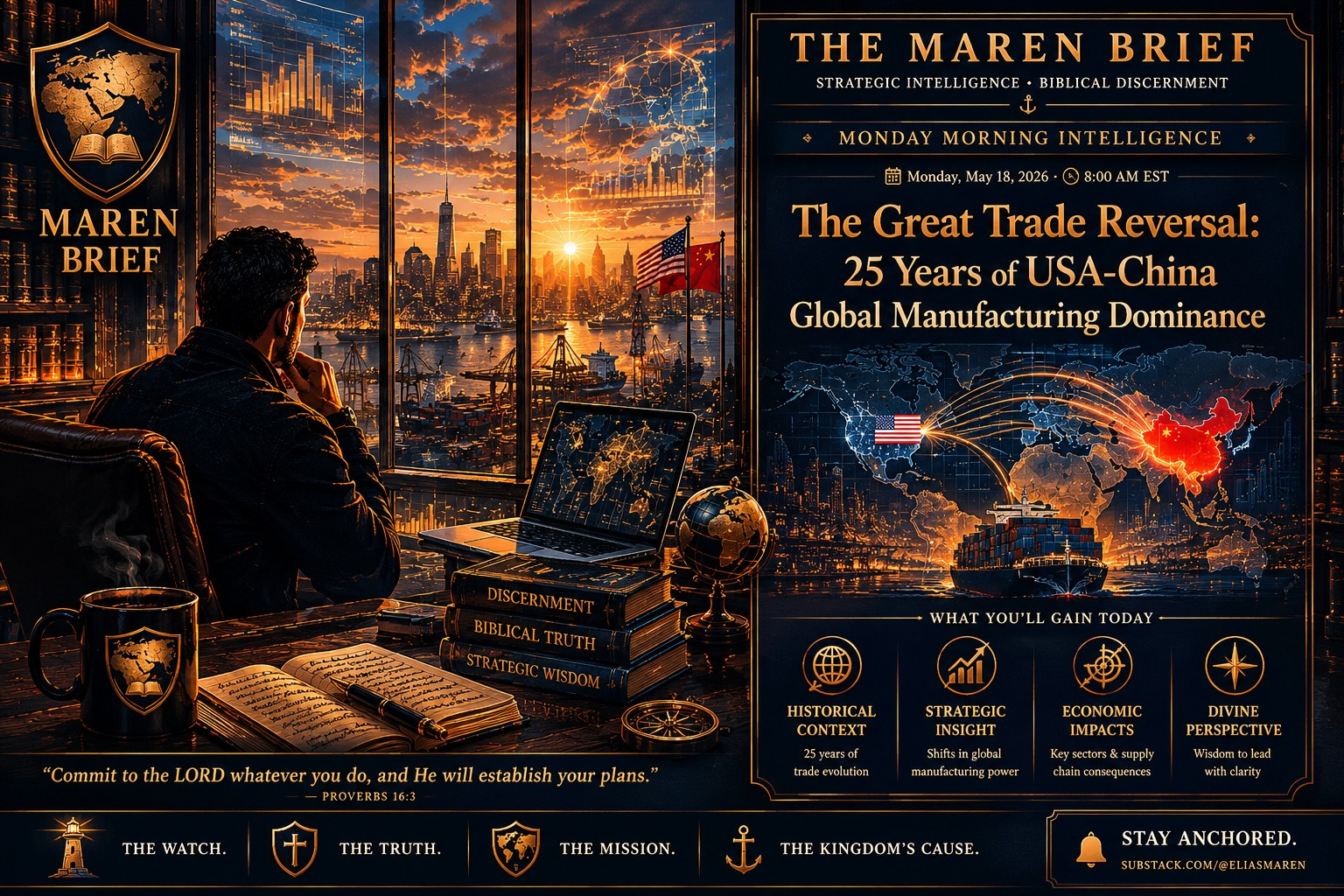
For twenty-five years, the story of the global economy has been the story of a single reversal.
In 2001, the year China joined the World Trade Organization, the United States was the manufacturing center of the world — roughly a quarter of everything manufactured on earth, by value, was made in America. China's share was a fraction of that.
Today the picture is inverted. By most measures China now produces close to a third of the world's manufactured goods — more, by some estimates, than the United States, Germany, and Japan combined. The Maren Brief for Monday, May 18 — published at 8:00 AM EST — traces how that reversal happened, what it cost, and what the next twenty-five years demand of American leadership.
The 25-Year Arc
The reversal did not arrive in a crisis. It happened in plain sight, one supply chain at a time.
- 2001 — China enters the WTO. Tariffs fall, capital flows in, and the great relocation of manufacturing begins.
- Around 2010 — China overtakes the United States to become the world's largest manufacturing nation.
- Today — China's share of global manufacturing output sits near 30 percent; the American share has fallen to roughly 15 to 17 percent.
Behind those figures is the deeper question: not only where things are made, but who holds the capability to make them. The full brief breaks the 25-year arc into the specific decisions, on both sides of the Pacific, that produced it.
Reading the Map
The trade map in this morning's brief tells the story faster than any spreadsheet. It shows finished goods flowing outward from a single concentrated center, raw and processed inputs flowing in, and a web of chokepoints — ports, straits, and shipping lanes — that the manufacturing center increasingly sits astride.
The visual makes one thing unmistakable: this is no longer only an economic story. Concentration of manufacturing is concentration of leverage. When one nation makes a third of the world's goods, every other nation's resilience runs through decisions made in its factories.
Beijing's Strategy
China's rise was not an accident of cheap labor. It was an industrial strategy, sustained across decades: move deliberately up the value chain, from low-cost assembly to advanced manufacturing; subsidize the sectors judged strategic; and convert manufacturing scale into control of the inputs everyone else depends on — processed critical minerals, components, and finished platforms.
The full brief assesses where that strategy is succeeding, where it is overextended, and the pressure points a serious competitor would press.
The American Response
The American response is still being written — and that is precisely the point of urgency.
A coherent framework has begun to form: reshoring strategic production, building supply chains with trusted allies rather than adversaries, and treating industrial capacity as a security question, not only an economic one. But frameworks are not outcomes. The brief lays out what a credible American response actually requires — and the cost of a decade more of drift.
The Stewardship Question
This morning's brief carries Proverbs 16:3: "Commit to the LORD whatever you do, and He will establish your plans."
A nation's manufacturing base is not merely a line on a GDP chart. It is the capacity to provide, to build, to withstand a shock without depending on the goodwill of a rival. Scripture treats productive work and the dignity of making things as a trust, not a transaction. Read that way, the great trade reversal is not only a strategic failure to be corrected — it is a stewardship question to be answered honestly.
That is the dimension no purely secular analysis will give you, and it is the dimension the Maren Brief is built to hold alongside the data.
Read the Full Brief
This blog preview is the outline. The Maren Brief for May 18 is the full briefing — the 25-year data in detail, the strategic assessment, the American response framework, and the faith-informed read, delivered in one disciplined intelligence briefing.
The reversal took twenty-five years to build. Understanding it should not take you twenty-five more. Read it while it is in front of you — or read it later, in hindsight, after the next decision has already been made for you.
Every subscriber also receives The Daily Anchor free — Scripture, motivation, and strategic clarity to anchor each morning before the news cycle reaches you.
Commit your work to the Lord. Read the signs. Lead with wisdom.
Explore the Full Catalog
20+ Titles Available on Amazon
Geopolitical intelligence. Military fiction. Faith-informed analysis. Browse the complete Elias Maren catalog on Amazon.
Visit the Amazon Author Page →
Elias Maren
Geopolitical analyst and author of the Global Chokepoints series, the Aegis Directive thrillers, and Nations in the Valley. Published by CoachDPrep Publishing.